



Table of Contents
PP honeycomb core is widely used in lightweight composite sandwich panels for commercial vehicles, recreational vehicles, industrial partitions, transportation flooring and other applications. Its low weight, cellular structure and moisture resistance make it an attractive alternative to conventional panel core materials.
However, bonding PP honeycomb core to fiberglass skins requires careful consideration of surface properties, adhesive compatibility and manufacturing conditions.
Unlike many conventional composite substrates, polypropylene has relatively low surface energy. This makes it difficult for standard adhesives and resin systems to form reliable bonds without suitable surface preparation or specially formulated adhesives.
For composite panel manufacturers, poor bonding can lead to skin delamination, reduced panel stiffness, local deformation and premature structural failure.
This guide explains how to bond polypropylene honeycomb to fiberglass skins, compares different PP honeycomb core configurations and identifies practical methods for improving sandwich panel bonding performance.
Why Is PP Honeycomb Core Difficult to Bond?
Understanding the Low Surface Energy of Polypropylene
Polypropylene is a non-polar thermoplastic polymer. Its chemically resistant surface has limited interaction with many conventional adhesive formulations.
Effective adhesive bonding requires the adhesive to wet the substrate surface and establish sufficient physical and chemical interactions.
When an adhesive does not adequately wet polypropylene, it may remain on the surface without establishing a durable connection. This can result in low initial bond strength, adhesive separation from the honeycomb surface, inconsistent bonding between production batches, reduced durability under temperature changes or repeated loading, and delamination between the core and fiberglass facing.
The issue becomes particularly important when manufacturing large PP honeycomb fiberglass sandwich panels that must withstand vibration, bending and repeated handling.
Surface Wettability and Adhesive Performance
Surface wettability describes how effectively a liquid adhesive spreads across a solid substrate.
A surface with insufficient wettability may prevent an adhesive from developing intimate contact with the underlying material.
Mechanical roughening alone does not necessarily resolve this problem because polypropylene's low surface energy is primarily associated with its surface chemistry.
Suitable surface activation methods or specialized low-surface-energy adhesives may therefore be required.
The Influence of Honeycomb Cell Geometry
Bonding a honeycomb core differs from bonding a solid sheet.
A bare PP honeycomb core typically provides a discontinuous bonding surface, where contact with the facing occurs mainly along the cell wall edges.
This introduces several challenges.
First, the effective adhesive contact area is limited by the honeycomb cell geometry.
Second, adhesive may flow into open cells instead of remaining at the bonding interface.
Third, excessive adhesive application can increase the overall sandwich panel weight.
Fourth, inadequate adhesive distribution may produce weak local bonds.
Finally, excessive consolidation pressure can distort or crush the honeycomb core.
Consequently, successful bonding depends on both the chemical compatibility of the adhesive and the physical design of the honeycomb interface.
Choosing the Right PP Honeycomb Core for Fiberglass Lamination
Before selecting an adhesive, manufacturers should identify which type of polypropylene honeycomb core is being used.
Different surface configurations require different bonding strategies.
1. Bare PP Honeycomb Core
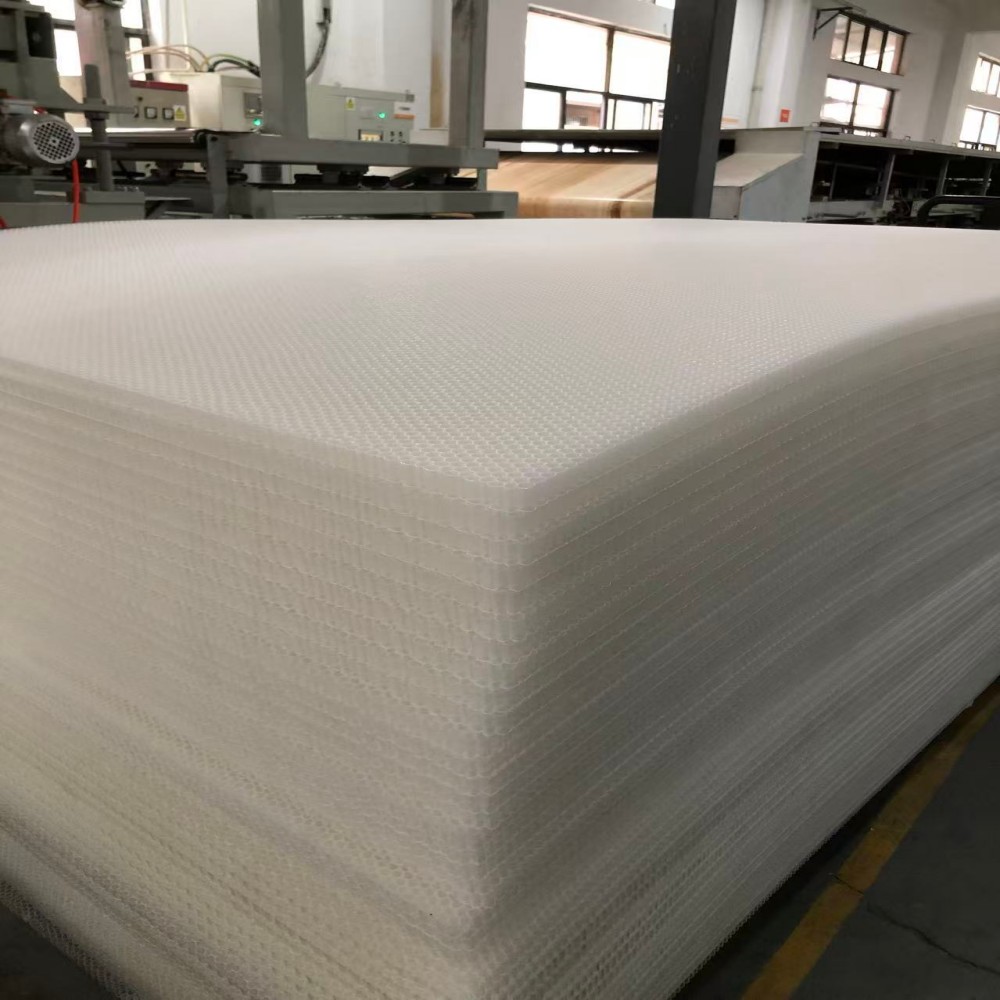
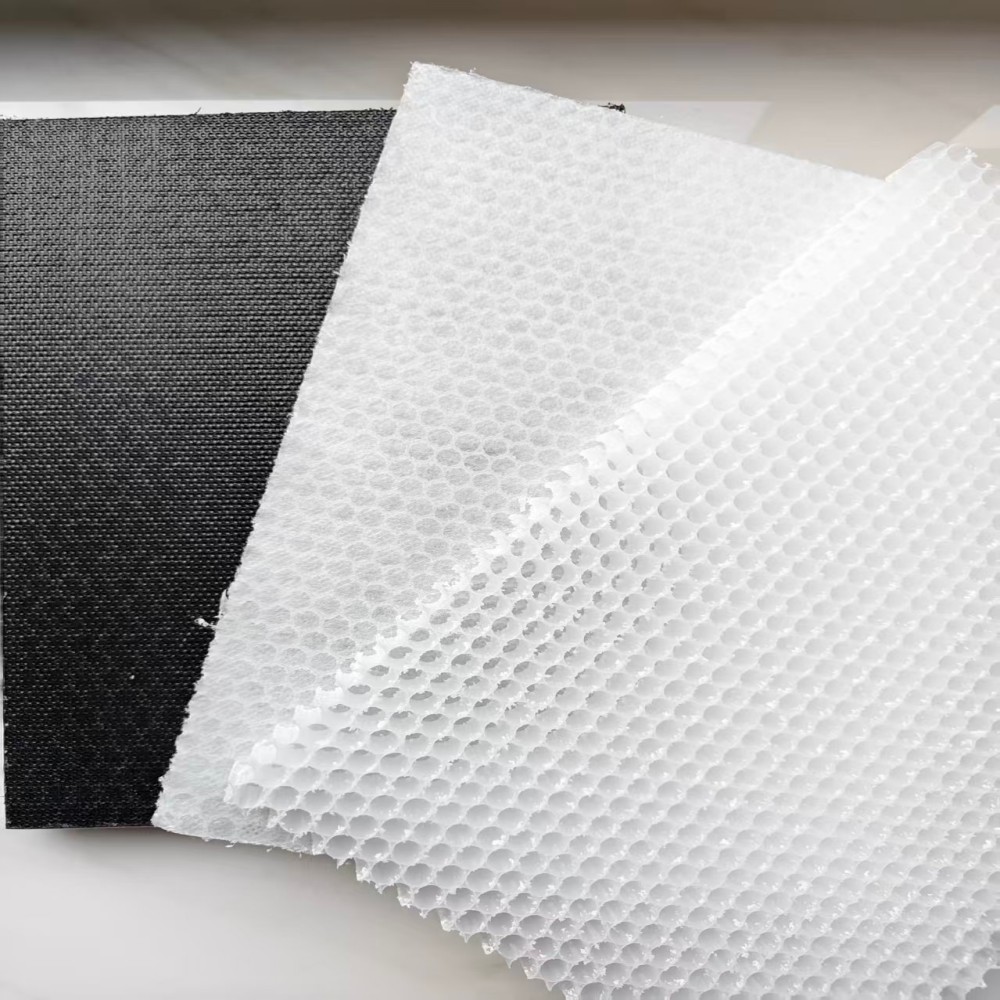
Bare PP honeycomb core consists of an exposed polypropylene cellular structure without an additional surface facing.
It offers flexibility for manufacturers developing customized composite panels.
However, its exposed polypropylene surfaces and discontinuous cell-wall contact can complicate adhesive bonding.
A bare core may require specialized adhesives, surface activation or an engineered bonding layer.
When Should You Choose Bare PP Honeycomb?
Bare PP honeycomb may be appropriate when manufacturers have established surface-treatment equipment, validated adhesives or a specialized lamination process.
It can also be considered for applications requiring customized core configurations.
However, suitability should be determined through actual laminate testing rather than assuming that a conventional fiberglass resin will bond directly to the polypropylene.
2. Non-woven Faced PP Honeycomb Core
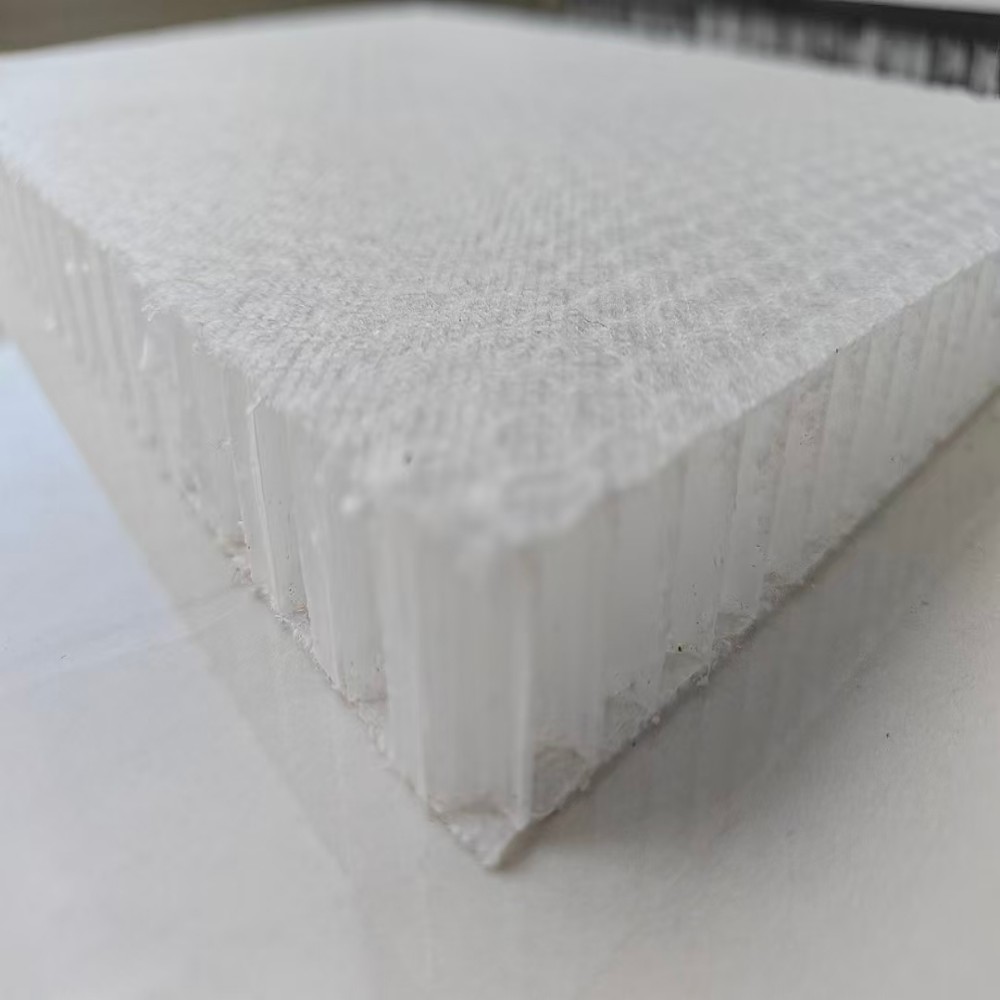
Non-woven faced PP honeycomb includes a surface layer designed to provide a more convenient interface for secondary lamination.
Compared with a bare honeycomb structure, the non-woven facing can provide a more continuous surface for adhesive application.
This may simplify the production of fiberglass reinforced PP honeycomb sandwich panels.
JLON offers non-woven faced PP honeycomb core for customers producing lightweight composite panels.
However, bonding performance depends on the non-woven material, its attachment to the PP core, and the compatibility of the chosen resin or adhesive.
Why Is Non-woven Facing Important?
An appropriately designed non-woven facing may improve resin distribution and provide a practical interface for lamination.
Nevertheless, manufacturers must verify two separate interfaces.
The first is the bond between the fiberglass skin and the non-woven facing.
The second is the bond between the non-woven facing and the polypropylene honeycomb core.
A strong fiberglass-to-non-woven bond does not automatically guarantee sufficient strength at the underlying core interface.
3. CFRT Faced PP Honeycomb Panels
Continuous Fiber Reinforced Thermoplastic (CFRT) faced PP honeycomb panels represent another construction approach.
Instead of relying on a conventional thermoset adhesive, compatible thermoplastic materials can be joined through controlled thermal fusion.
JLON supplies CFRT faced PP honeycomb panels for transportation and industrial applications.
These products should not be confused with bare PP honeycomb cores designed for secondary bonding to fiberglass skins.
Thermal fusion and adhesive bonding are different manufacturing processes, and each requires its own temperature, pressure and performance validation.
Surface Treatment Methods for PP Honeycomb Bonding
Surface preparation is one of the most important considerations when bonding untreated polypropylene.
Several methods can modify polypropylene surfaces to improve adhesive wettability.
Plasma Surface Treatment
Plasma treatment uses an energized gas to modify the chemistry of a polymer surface.
It can introduce polar functional groups that improve surface wettability and support adhesive bonding.
Plasma treatment may be considered for polypropylene components where conventional adhesives provide insufficient adhesion.
Potential benefits include improved surface wettability, enhanced compatibility with selected adhesives, limited modification of the bulk material when properly controlled, and a potentially more consistent bonding interface.
However, treatment settings must be optimized for the actual honeycomb geometry and polypropylene formulation.
Can Plasma Treatment Be Used on Honeycomb Cores?
Potentially, but an open-cell honeycomb structure creates additional challenges.
Treatment must reach the surfaces that will actually contact the adhesive.
For a large panel, equipment accessibility, treatment uniformity and production speed should all be evaluated.
The treated surface may also change during storage, so the interval between treatment and bonding should be controlled.
Corona Surface Treatment
Corona treatment uses an electrical discharge to modify the surface properties of polymers.
It is widely associated with improving the printability and adhesion of polyolefin materials.
For polypropylene honeycomb applications, corona treatment may improve the wettability of accessible bonding surfaces.
Its effectiveness depends on equipment design, electrode geometry, exposure conditions and the core surface configuration.
Manufacturers should verify uniform treatment rather than assuming that processing a sheet through corona equipment automatically activates every exposed cell-wall edge.
Flame Surface Treatment
Controlled flame treatment can oxidize the surface of polypropylene and increase its surface energy.
However, polypropylene is a thermoplastic material, and an open honeycomb structure may be sensitive to localized heating.
Inappropriate treatment can cause cell-wall deformation, melting or changes in surface properties.
For this reason, flame treatment should be evaluated only using suitable industrial equipment, validated process controls and appropriate safety procedures.
Mechanical Abrasion and Cleaning
Cleaning removes dust, grease and other contaminants that may interfere with adhesive bonding.
Light mechanical abrasion may modify surface texture in selected applications.
However, abrasion alone generally does not eliminate polypropylene's fundamental low-surface-energy characteristics.
Aggressive sanding may also damage thin honeycomb cell walls.
For PP honeycomb cores, cleaning and abrasion should therefore be viewed as parts of an approved surface-preparation process, not universal solutions.
Selecting Adhesives for PP Honeycomb and Fiberglass Skins
The best adhesive depends on the honeycomb surface, fiberglass skin material, operating environment and panel manufacturing process.
Structural Acrylic Adhesives
Certain structural acrylic adhesives are specifically formulated to bond low-surface-energy polyolefins, including polypropylene.
These materials may offer an alternative to extensive surface treatment.
When evaluating an acrylic adhesive, manufacturers should confirm its compatibility with polypropylene and the fiberglass skin matrix, its open time and curing conditions, its resistance to service temperatures, and its bond performance under expected loading conditions.
An adhesive marketed for polypropylene bonding should still be tested on the actual honeycomb geometry.
Epoxy Adhesives
Epoxy adhesives are commonly used in fiberglass reinforced composite structures.
They can provide strong adhesion to many properly prepared thermoset composite surfaces.
However, conventional epoxy systems generally do not bond reliably to untreated polypropylene without suitable surface modification or a compatible intermediate layer.
For a PP honeycomb fiberglass panel, epoxy bonding may be appropriate when the honeycomb surface has been suitably prepared or supplied with a compatible facing.
The epoxy formulation and complete panel construction must be validated.
Polyurethane Adhesives
Polyurethane adhesives are available in rigid, semi-rigid and flexible formulations.
Selected industrial polyurethane systems may be suitable for sandwich panel manufacturing.
Their potential advantages include flexibility, gap-filling capability and compatibility with various panel materials.
However, polypropylene compatibility varies considerably among formulations.
Manufacturers should select an adhesive based on confirmed substrate compatibility rather than adhesive category alone.
Comparison of Bonding Approaches
Low-Surface-Energy Structural Acrylic Bonding
Specialized structural acrylic adhesives may be suitable for bare polypropylene honeycomb when the adhesive is compatible with the material and the cell geometry allows adequate bonding contact.
The main consideration is maintaining adhesive coverage and controlling the bond line.
Epoxy Adhesive Bonding
Epoxy adhesives may be appropriate for treated PP honeycomb or honeycomb with a compatible non-woven facing.
Their effectiveness depends on interface preparation, resin compatibility and curing conditions.
Polyurethane Adhesive Bonding
Selected polyurethane adhesives may be suitable for industrial sandwich panel applications.
The primary considerations include polypropylene compatibility, mechanical performance and environmental durability.
Thermoplastic Fusion Bonding
Compatible thermoplastic honeycomb and facing materials may be joined through controlled thermal fusion.
Unlike conventional adhesive bonding, this process relies on suitable thermal processing conditions and compatible thermoplastic interfaces.
There is no universally best adhesive for every PP honeycomb construction.
The correct choice is the system that achieves the required bond strength and durability in the finished sandwich panel.
Step-by-Step Process for Bonding PP Honeycomb to Fiberglass Skins
The following workflow provides a general development approach for manufacturers using adhesive-bonded sandwich construction.
Actual production parameters must be established through trials and adhesive supplier recommendations.
Step 1: Identify the Core and Facing Materials
Confirm whether the PP honeycomb is bare, non-woven faced or supplied as a pre-laminated panel.
Identify the fiberglass facing composition, including whether it is an epoxy laminate, polyester laminate, glass fiber reinforced thermoplastic or another material.
Different facing resins may require different adhesives and surface preparation.
Step 2: Prepare the Bonding Surfaces
Inspect the PP honeycomb and fiberglass facing for dust, oils, moisture and damage.
Clean the surfaces using a method compatible with both substrates.
If the chosen adhesive requires plasma, corona or another approved treatment, perform the treatment according to the validated procedure.
Avoid unapproved solvent exposure or excessive heating that could damage the core.
Step 3: Apply the Adhesive
Apply the selected adhesive using a controlled method appropriate to the honeycomb surface.
For bare honeycomb structures, adhesive placement must account for the limited contact area along the cell walls.
For non-woven faced honeycomb, the adhesive may be distributed across the engineered facing surface.
How Much Adhesive Should Be Applied?
The correct adhesive quantity depends on the cell geometry, facing configuration, adhesive viscosity and required bond-line dimensions.
Insufficient adhesive may produce incomplete bonding, while excessive adhesive may increase weight or flow into the honeycomb cells.
Adhesive consumption should be established through production trials rather than a single universal coating-weight recommendation.
Step 4: Assemble the Sandwich Panel
Position the PP honeycomb between the prepared fiberglass skins.
Maintain alignment and avoid moving the components once the adhesive begins to develop its bond.
For double-sided panels, both interfaces should be prepared consistently.
Any local inserts, edge reinforcements or high-load attachment areas should be incorporated according to the panel design.
Step 5: Apply Controlled Consolidation Pressure
Consolidation pressure helps establish contact between the adhesive and bonding surfaces.
However, excessive pressure can damage a lightweight honeycomb core or cause adhesive starvation.
Pressure should be distributed uniformly and remain within the validated limits of the complete panel construction.
Vacuum bagging may be considered for selected processes, but it is not automatically suitable for every PP honeycomb density or geometry.
Step 6: Cure and Inspect the Panel
Allow the adhesive to cure under the specified temperature and environmental conditions.
Avoid releasing the panel from its fixture before it has developed sufficient handling strength.
After curing, inspect for visible delamination, panel deformation, poor edge bonding and other defects.
For structural applications, visual inspection alone is insufficient; representative bond testing should be performed.
Common PP Honeycomb Bonding Failures and Solutions
Adhesive Separation From the Core
Adhesive separation from the polypropylene core may result from poor surface wettability, contamination, incompatible adhesive selection or insufficient surface treatment.
To investigate the problem, manufacturers should examine the failed surface and determine whether separation occurred at the polypropylene interface.
Potential corrective actions include selecting an adhesive specifically designed for low-surface-energy materials or introducing a validated surface activation process.
Fiberglass Skin Delamination
Fiberglass skin delamination may result from inadequate bonding, insufficient adhesive coverage, unsuitable surface preparation or excessive service loads.
Manufacturers should determine whether failure occurred within the fiberglass laminate, adhesive layer, non-woven facing or core-to-facing interface.
Each failure location may require a different corrective action.
Excessive Panel Weight
Excessive panel weight may result from overapplication of adhesive, adhesive penetration into the honeycomb cells or unnecessary reinforcement.
Manufacturers should measure adhesive consumption and investigate whether a different facing configuration can provide sufficient bonding with more controlled adhesive distribution.
Core Deformation During Pressing
Core deformation may occur when consolidation pressure or processing temperature exceeds the limits of the honeycomb structure.
Manufacturers should evaluate the pressing conditions against the actual compression behavior of the core.
A lower-density honeycomb core should not automatically be processed under the same conditions as a higher-density product.
How to Test PP Honeycomb Sandwich Panel Bond Strength
Bonding validation should reflect the intended panel application.
Flatwise Tensile Testing
ASTM C297/C297M provides a method for evaluating flatwise tensile strength in sandwich constructions.
It can help identify whether failure occurs in the core, at the core-to-facing interface or within the facing itself.
This is particularly useful for comparing different adhesive and surface-treatment combinations.
Flexural Testing
ASTM C393/C393M addresses flexural properties of flat sandwich constructions.
Testing can help manufacturers evaluate the behavior of completed sandwich panels under bending loads.
However, a flexural test is not a substitute for direct adhesive-interface evaluation.
Environmental Durability Testing
Panels used outdoors or in transportation applications may experience temperature cycling, moisture exposure, vibration, repeated bending loads and mechanical impact.
These conditions can affect the adhesive interface and the overall sandwich panel structure.
For example, temperature cycling may create stresses due to differences in thermal expansion between polypropylene, fiberglass skins and the adhesive layer.
Moisture exposure may affect certain adhesive systems or facing materials, even though polypropylene itself has relatively low moisture absorption.
Vibration and repeated bending can introduce cyclic stresses that gradually weaken an inadequately designed bonding interface.
Mechanical impact may cause localized core damage, skin cracking or delamination.
The test program should reflect actual service conditions and the intended design life.
Why Is Failure Mode Important?
A measured peak force does not tell the complete story.
Failure in the adhesive interface, core material or fiberglass skin can indicate different limitations.
Recording the failure mode helps engineers determine whether further adhesive development, material selection or panel redesign is required.
Applications of Fiberglass PP Honeycomb Sandwich Panels
Truck Bodies and Commercial Vehicles
Lightweight fiberglass PP honeycomb sandwich panels may be used in selected truck body components, partitions and non-metallic panels.
Reducing unnecessary panel weight can help optimize vehicle design.
However, flooring, wall and structural applications may have different stiffness, impact and attachment requirements.
RV and Caravan Panels
PP honeycomb sandwich construction is used in lightweight caravan and recreational vehicle applications.
Suitable panel design can combine low weight with practical moisture resistance.
Bonding quality is important because large panels may experience temperature variations, vibration and repeated loading.
Industrial Partitions and Equipment Panels
Fiberglass faced honeycomb panels may also be considered for industrial partitions, protective covers and other lightweight assemblies.
Material selection should account for fastening methods, edge sealing and the required mechanical properties.
JLON PP Honeycomb Core Solutions
JLON supplies PP Honeycomb Core for lightweight composite sandwich panel manufacturing.
The product range includes bare PP honeycomb core, non-woven faced PP honeycomb core and CFRT faced PP honeycomb panels.
These options support different manufacturing approaches.
Bare PP honeycomb is suitable for customers developing customized lamination processes.
Non-woven faced PP honeycomb provides an engineered surface for secondary lamination.
CFRT faced PP honeycomb panels offer an alternative construction based on compatible thermoplastic skins.
When selecting a product, customers should consider core thickness, density, cell geometry, facing construction, processing method and finished-panel performance requirements.
Explore the JLON PP Honeycomb Core product range:
https://www.jloncell.com/pp-honeycomb-core.html
For a new sandwich panel project, providing the fiberglass skin type, intended adhesive, panel dimensions and performance requirements will help define a suitable core configuration for evaluation.
Frequently Asked Questions About PP Honeycomb Bonding
Can PP Honeycomb Core Be Bonded Directly to Fiberglass?
Yes, with a suitably engineered bonding process. However, untreated polypropylene can be difficult to bond using conventional adhesives.
Manufacturers should use a compatible adhesive, validated surface treatment or an engineered facing layer.
What Is the Best Adhesive for PP Honeycomb Core?
There is no universal answer.
Certain low-surface-energy structural acrylic adhesives can bond polypropylene, while selected epoxy or polyurethane systems may be suitable for appropriately prepared or faced honeycomb structures.
The finished panel must be tested.
Is Non-woven Faced PP Honeycomb Easier to Laminate?
It can simplify secondary lamination by providing a more continuous bonding interface.
However, the facing material, its attachment to the core and the selected adhesive must all be compatible.
Can Polyester Resin Bond Directly to Bare PP Honeycomb?
Conventional polyester laminating resin should not be assumed to form a reliable structural bond to untreated polypropylene.
A compatible facing, specialized treatment or alternative bonding system may be needed.
Is Vacuum Bagging Suitable for PP Honeycomb Panels?
Vacuum bagging may be suitable for some adhesive-bonding processes, provided the core can withstand the applied pressure and the adhesive remains appropriately distributed.
Manufacturers should validate the process before full-scale production.
How Can Manufacturers Reduce Delamination?
A practical approach is to identify the weakest interface, select compatible materials, control surface preparation and bonding conditions, and verify performance through mechanical and environmental testing.
Conclusion
Bonding PP honeycomb core to fiberglass skins requires more than choosing a general-purpose adhesive.
The most important factors are polypropylene surface wettability, honeycomb cell geometry, adhesive compatibility, surface preparation and controlled consolidation.
For manufacturers using bare PP honeycomb, specialized adhesives or suitable surface treatments may be necessary.
For manufacturers seeking a more convenient secondary lamination process, non-woven faced PP honeycomb can be worth evaluating.
JLON provides different PP honeycomb core solutions to support lightweight fiberglass sandwich panel manufacturing.
By selecting an appropriate core configuration and validating the complete bonding process, manufacturers can develop more consistent and reliable composite sandwich panels.
Contact JLON to discuss PP honeycomb core specifications, facing options and sample requirements for your next composite panel project


