



Wind turbine blades must be light enough to rotate efficiently, yet stiff and durable enough to withstand changing aerodynamic loads and millions of fatigue cycles. As blades become longer, choosing the right wind turbine blade core materials becomes increasingly important to structural performance, manufacturing efficiency and finished blade weight.
Balsa wood, PVC foam and PET foam are three established core material families used in composite sandwich structures. They are not interchangeable, and no single material is automatically best for every blade or every location.
Balsa provides strong through-thickness mechanical properties. Cross-linked PVC foam offers a mature balance of strength, toughness and fatigue performance. PET foam combines scalable production, recyclability and competitive cost with a broad range of available grades.
The correct choice depends on the blade design, local loading, core density and thickness, resin infusion process, curing temperature, resin uptake, fatigue requirements and customer qualification.
This guide explains how balsa wood core, PVC foam core and PET foam core differ and how wind turbine blade manufacturers can select the appropriate core material.
Table of Contents
Why Wind Turbine Blades Need Core Materials
A wind turbine blade shell is not simply a thick solid laminate. Many blade sections use a sandwich structure consisting of:
① An outer composite skin
② A lightweight core material
③ An inner composite skin
The skins are commonly reinforced with fiberglass or carbon fiber. The core separates and stabilizes the two skins.
Separating the skins increases the total section thickness and significantly improves bending stiffness without adding the weight of an equivalent solid laminate. The skins carry much of the tensile and compressive loading, while the core transfers shear between them and helps prevent local buckling.
In wind turbine blades, structural core materials can help:
① Increase panel stiffness without excessive weight
② Transfer shear between laminate skins
③ Stabilize large blade shell areas
④ Improve resistance to local buckling
⑤ Maintain the aerodynamic shape of the blade
⑥ Reduce the amount of solid laminate required
⑦ Support repeatable production of large composite structures
The core must therefore be selected as part of the complete sandwich structure. Nominal density alone does not determine whether a wind turbine blade core material is suitable.
Balsa Wood Core for Wind Turbine Blades
Balsa is a natural end-grain core material with a long application history in the wind energy industry.
Its cellular structure can provide high compressive and shear properties, making it suitable for sandwich structures requiring strong through-thickness mechanical performance.
Advantages of Balsa Wood Core
The main advantages of balsa wood core include:
① Strong compressive and shear properties
② High stiffness compared with many lightweight core materials
③ Good fatigue performance in qualified applications
④ Compatibility with common composite resin systems
⑤ Long application history in wind turbine blades
⑥ Availability in sheets and contourable formats
Balsa remains an important wind turbine blade core material where high compressive strength, shear strength and stiffness are required.
Limitations of Balsa Wood Core
Balsa is a biological material. Its density, cell structure and mechanical properties can vary according to growing conditions, tree age, drying methods, block selection and processing quality.
Professional balsa suppliers control these variations through material grading and quality inspection. However, blade manufacturers must still evaluate qualified product data rather than relying on generic values for “balsa wood.”
Balsa can also absorb more resin than closed-cell structural foam, particularly around joints, cuts and exposed cells. In large wind turbine blade areas, additional resin can increase material consumption and finished blade weight.
Its supply chain is more geographically concentrated than that of synthetic foam cores. Rapid changes in global demand can therefore affect balsa availability, lead time and price.
These limitations have encouraged wind turbine blade manufacturers to evaluate PET foam and PVC foam alternatives. However, they do not mean balsa can be replaced without structural redesign and validation.
PVC Foam Core for Wind Turbine Blades
Cross-linked PVC foam is a closed-cell structural foam core with a mature application history in demanding composite structures.
A suitable PVC foam core for wind turbine blades offers a strong balance of low weight, shear and compression performance, toughness, fatigue resistance and processing reliability.
Advantages of PVC Foam Core
The main advantages of PVC foam core include:
① Good strength-to-weight ratio
② Good stiffness-to-weight ratio
③ Good fatigue resistance in qualified grades
④ Low water absorption
⑤ Broad density and thickness range
⑥ Compatibility with common composite resin systems
⑦ Suitability for vacuum infusion and other composite processes
⑧ Easy grooving, perforation, scoring and CNC machining
⑨ Established processing and qualification experience
PVC foam core may be considered for:
① Blade shell sandwich sections
② Shear webs
③ Selected higher-load sandwich areas
④ Nacelle panels
⑤ Spinner structures
⑥ Other lightweight composite components
The exact application depends on the mechanical properties of the selected PVC foam grade and the approved wind turbine blade design.
Limitations of PVC Foam Core
PVC foam is based on petrochemical raw materials, so its cost can be affected by changes in feedstock and energy prices.
Standard PET foam is often more cost-effective for large-volume applications. The processing temperature capability of PVC foam also varies by grade and must be checked against:
① Mould temperature
② Resin exotherm
③ Curing temperature
④ Cure duration
⑤ Post-curing requirements
“PVC foam” alone is not a complete material specification. Density, formulation, temperature grade, cell structure and surface treatment all influence its performance.
The PVC foam core supplier should provide technical data for the exact density and grade being evaluated.
PET Foam Core for Wind Turbine Blades
PET foam is a thermoplastic structural foam widely used in large composite sandwich structures.
PET foam core for wind turbine blades offers competitive cost, scalable production and the possibility of using recycled PET feedstock.
Advantages of PET Foam Core
The main advantages of PET foam core include:
① Good compressive and shear properties in suitable grades
② Competitive cost for large-volume blade production
③ Recyclable thermoplastic material
④ Availability of recycled-content grades
⑤ Good thermoformability
⑥ Compatibility with vacuum infusion
⑦ Broad density range
⑧ Different processing-temperature grades
⑨ Scalable and geographically diversified raw-material supply
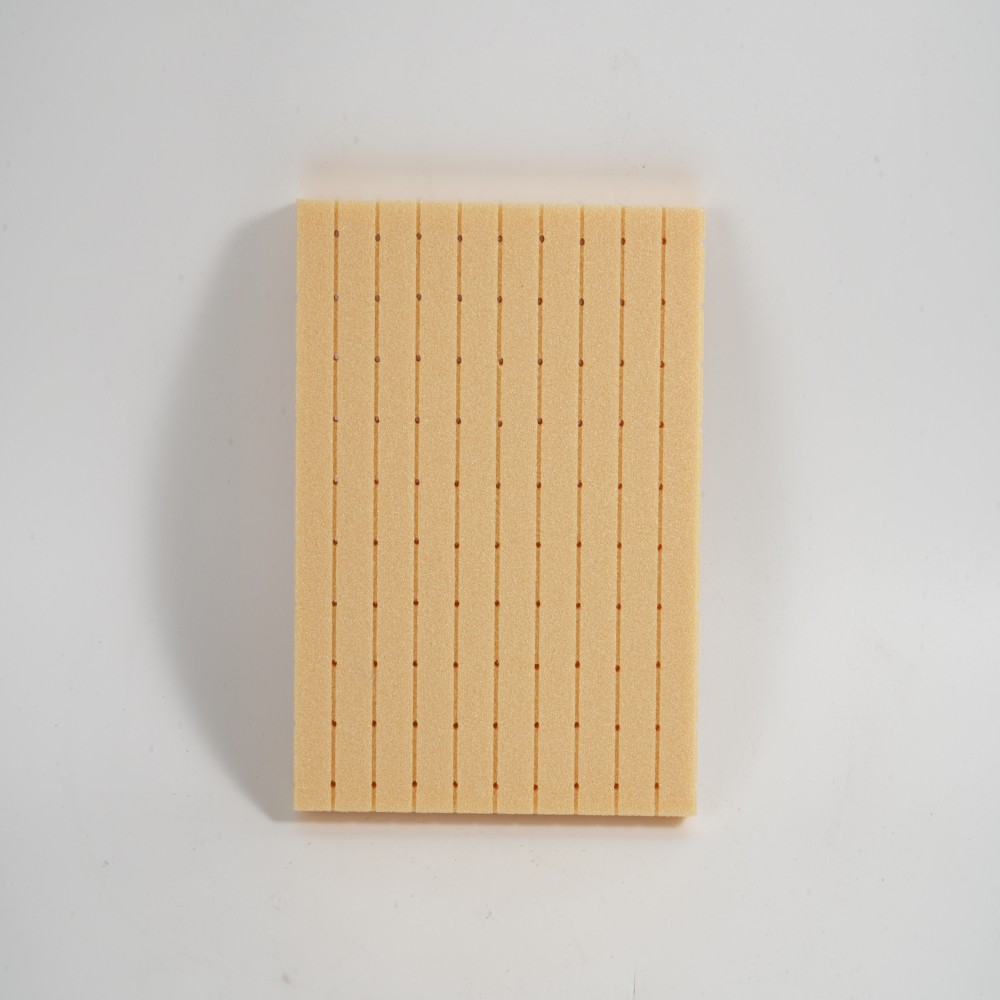
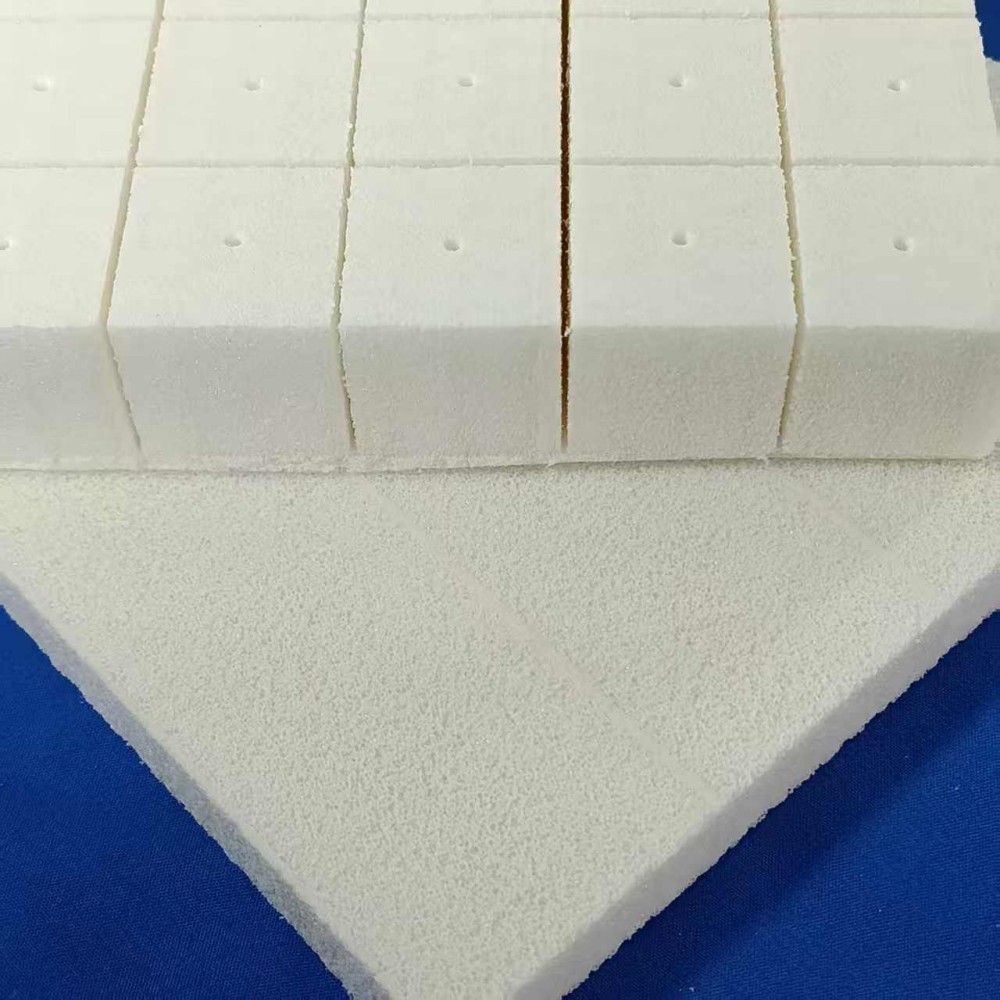
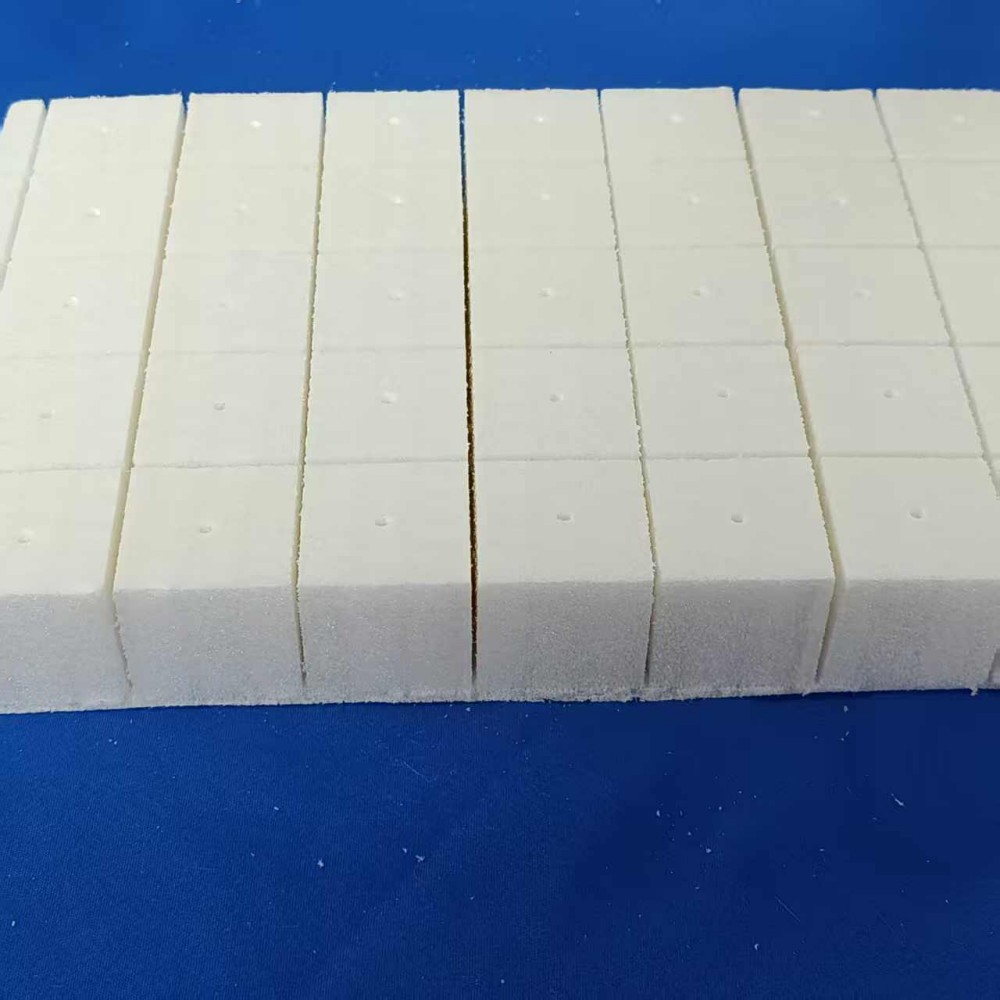
PET foam can be supplied as:
① Plain sheets
② Grooved sheets
③ Perforated sheets
④ Grooved and perforated sheets
⑤ Scored and scrim-backed panels
⑥ Thermoformed components
⑦ CNC-machined core kits
This processing flexibility makes PET foam suitable for curved blade shells and serial wind turbine blade production.
Limitations of PET Foam Core
PET foam grades differ considerably in:
① Cell structure
② Mechanical performance
③ Brittleness
④ Temperature resistance
⑤ Resin uptake
⑥ Surface quality
⑦ Dimensional stability
Some lower-density or standard PET foam grades may not provide the performance required in structurally demanding blade areas.
Cutting quality, edge integrity and dimensional recovery after thermal processing must also be controlled.
PET foam should not be selected only because it is recyclable or less expensive. The actual PET foam grade must satisfy static, fatigue, bonding and processing requirements as part of the complete sandwich structure.
Balsa vs PVC vs PET: Practical Comparison
Material Type
Balsa wood core: Natural end-grain wood.
PVC foam core: Cross-linked structural polymer foam.
PET foam core: Thermoplastic structural foam.
Main Advantage
Balsa wood core: Strong through-thickness mechanical properties.
PVC foam core: Balanced structural performance, toughness and fatigue resistance.
PET foam core: Cost efficiency, scalability, thermoformability and recyclability.
Property Consistency
Balsa wood core: Requires careful grading and quality control.
PVC foam core: Generally consistent under controlled production.
PET foam core: Generally consistent, but properties vary by grade.
Resin Uptake
Balsa wood core: Can be relatively high.
PVC foam core: Usually low, depending on the finishing pattern.
PET foam core: Usually low, depending on the grade and finishing pattern.
Processing
Balsa wood core: Compatible with common resin systems and core formats.
PVC foam core: Easy to machine, groove, perforate and contour.
PET foam core: Suitable for machining, infusion and thermoforming.
Supply Chain
Balsa wood core: More geographically concentrated.
PVC foam core: Diversified industrial supply.
PET foam core: Scalable supply with recycled-content options.
Typical Selection Logic
Balsa wood core: Qualified areas requiring strong through-thickness performance.
PVC foam core: Areas prioritizing fatigue, toughness and mechanical efficiency.
PET foam core: Areas prioritizing cost, production scale and sustainability.
This comparison is only a general selection guide.
Technical properties should be compared at equivalent densities and under comparable test conditions. Test standard, material direction, temperature and conditioning method can all affect the results.
How Blade Location Affects Core Material Selection
A wind turbine blade does not necessarily use one core material or density from root to tip.
Local geometry and loading vary considerably. Several core densities—or several core material families—may be used within one blade design.
Blade Shell Sandwich Areas
Large blade shell panels require sufficient stiffness to maintain their aerodynamic shape and resist local buckling.
PET foam, PVC foam or balsa may be specified depending on:
① Local shear requirements
② Core thickness
③ Panel geometry
④ Weight target
⑤ Resin infusion process
⑥ Qualification history
Conformability and accurate fit against the mould are especially important in curved blade shell areas.
Shear Webs
Shear webs connect the two blade shells and help maintain the separation of the load-carrying spar caps.
Core materials used in sandwich shear webs require:
① Dependable shear properties
② Dimensional stability
③ Reliable bonding to laminate skins
④ Accurate machining and kit dimensions
⑤ Consistent thickness
⑥ Suitable fatigue performance
Gaps or poorly fitted joints between core kit components can create resin-rich areas and reduce manufacturing consistency.
Leading and Trailing Edges
Selected leading-edge and trailing-edge regions may use core materials to stabilize the blade shell and increase local stiffness.
These areas can include tight curvature and complex thickness transitions. As a result, the following factors may be as important as the nominal mechanical properties:
① Thermoformability
② Scoring pattern
③ Core flexibility
④ Kit accuracy
⑤ Edge quality
⑥ Dimensional tolerances
Root and High-Load Transitions
The blade root contains thick laminates, inserts, bonded joints and localized load-transfer features.
It is incorrect to assume that one standard low-density foam or one universal balsa grade is suitable throughout this area.
Higher-density core materials, specialized inserts or alternative structural solutions may be required according to the blade designer’s structural calculations.
The spar cap itself is normally a heavily reinforced load-carrying laminate. Core material discussions should clearly distinguish the spar cap from adjacent blade shell sandwich areas and shear webs.
Can PET Foam Replace Balsa in Wind Turbine Blades?
PET foam can replace balsa in some wind turbine blade sandwich structures. However, replacement is an engineering process—not a direct one-for-one material substitution.
Balsa and PET foam have different:
① Stress-strain behavior
② Shear response
③ Through-thickness performance
④ Bonding characteristics
⑤ Fatigue behavior
⑥ Failure modes
⑦ Resin absorption characteristics
Replacing balsa wood core with PET foam may require changes to:
① Core density
② Core thickness
③ Skin laminate
④ Local reinforcement
⑤ Panel geometry
⑥ Joints and transitions
⑦ Processing conditions
The evaluation should include:
① Static shear and compression properties
② Fatigue performance under representative loading
③ Skin-to-core bond performance
④ Resin uptake and finished panel weight
⑤ Cure-cycle and temperature stability
⑥ Dimensional tolerances
⑦ Core kit fit
⑧ Representative sandwich-panel testing
⑨ Blade-level structural analysis
⑩ Customer qualification
PET foam has become an important wind turbine blade core material, particularly where production scale, cost efficiency, consistent supply and recycled content are priorities.
However, balsa continues to provide valuable mechanical properties. PVC foam also retains advantages in mature structural foam performance, toughness and fatigue-critical applications.
The likely long-term solution is optimized material allocation rather than the universal replacement of one material by another.
Do Not Select Core Material by Turbine MW Rating Alone
A simple rule such as “PET foam below a certain turbine rating and PVC foam above it” is not technically reliable.
Rated power does not fully describe:
① Blade length
② Blade shell geometry
③ Rotor speed
④ Onshore or offshore conditions
⑤ Number and position of shear webs
⑥ Spar-cap design
⑦ Target blade weight
⑧ Safety factors
⑨ Design life
⑩ Infusion and curing process
Two wind turbine blades with similar MW ratings may use different core materials, densities and thicknesses.
The blade drawing, laminate schedule, structural specification and qualification requirements must take priority over general rules based on turbine power rating.
A Practical Core Material Selection Process
Wind turbine blade manufacturers can follow a structured selection process.
Step 1: Identify the Blade Location
Determine whether the core will be used in a blade shell, shear web, leading edge, trailing edge or localized transition area.
Step 2: Define Structural Requirements
Confirm the required:
① Shear strength
② Shear modulus
③ Compressive strength
④ Compression modulus
⑤ Fatigue performance
⑥ Core thickness
⑦ Allowable finished weight
Step 3: Define Processing Conditions
Provide the resin system, infusion method, vacuum level, mould temperature, resin exotherm, cure temperature and cure duration.
Step 4: Compare Balsa, PVC and PET Grades
Compare actual technical data at equivalent densities and under comparable test conditions.
Do not compare only general material-family descriptions.
Step 5: Select the Surface Treatment
Select perforations, grooves, scoring, scrim backing or thermoforming according to blade geometry and resin-flow requirements.
Step 6: Evaluate Resin Consumption
Measure the influence of grooves, perforations, scoring cuts and joints on finished panel weight and material cost.
Step 7: Confirm Core Kit Requirements
Provide drawings, dimensional tolerances, part identification, packaging sequence and expected annual volume.
Step 8: Validate the Complete Sandwich System
Produce representative trial panels using the intended skins, resin, adhesive, core material and manufacturing process.
The final material should be approved only after structural and processing validation.
JLON PVC and PET Foam Core Solutions
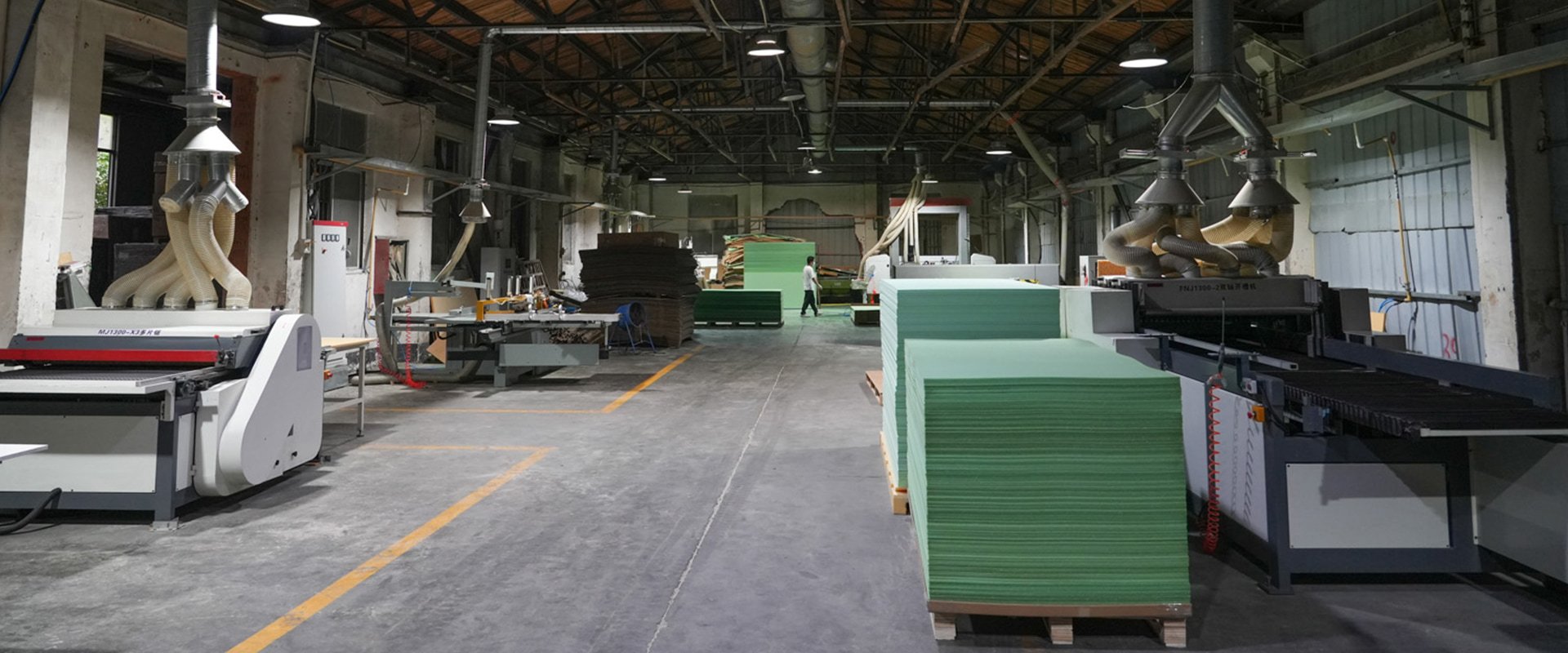
JLON supplies PVC foam core and PET foam core for wind turbine blade manufacturing.
Available supply and processing options include:
① Multiple densities and thicknesses
② Standard foam core sheets
③ Grooved sheets
④ Perforated sheets
⑤ Grooved and perforated sheets
⑥ Contour-scored foam
⑦ Scrim-backed foam
⑧ Beveled and tapered components
⑨ Thermoformed PET foam
⑩ CNC-machined components
⑪ Drawing-based wind blade core kits
⑫ Customized packing and part identification
Finishing patterns should be designed around the customer’s resin infusion strategy.
Groove width and depth, hole diameter and spacing, scoring pattern and gaps between core pieces can all affect resin flow, resin consumption and finished blade weight.
Customers can provide drawings, resin information, curing conditions and required tolerances for manufacturing review.
Final Recommendation
There is no universal winner in the comparison of balsa vs PVC vs PET.
Balsa wood core offers strong through-thickness mechanical properties and a long application history.
PVC foam core provides a mature balance of structural efficiency, fatigue performance, toughness and processing flexibility.
PET foam core offers competitive cost, scalable supply, thermoformability, recyclability and recycled-content options.
The best wind turbine blade core materials are those matched to the structural and manufacturing requirements of each blade section.
In many designs, using different materials or densities in different areas provides a better balance than specifying one core material throughout the entire blade.
For an initial material recommendation, provide JLON with:
① Application area
② Required density
③ Required thickness
④ Mechanical property targets
⑤ Resin system
⑥ Infusion method
⑦ Cure cycle
⑧ Surface treatment
⑨ Drawings and tolerances
⑩ Testing requirements
⑪ Estimated annual volume
Our team can recommend an appropriate PVC foam core or PET foam core configuration for sampling, production trials and customer validation.
Frequently Asked Questions
Which core materials are used in wind turbine blades?
Balsa wood, PVC foam and PET foam are established wind turbine blade core materials. The appropriate material depends on blade location, structural requirements, density, thickness, manufacturing process and the qualified blade design.
Is PET foam better than PVC foam for wind turbine blades?
Neither material is automatically better. PET foam supports cost-efficient, scalable and recyclable construction. Suitable PVC foam grades offer strong structural efficiency, toughness and fatigue performance.
The comparison should use product-specific technical data at equivalent densities and test conditions.
Can PET foam replace balsa wood core?
PET foam can replace balsa in some sandwich structures, but it should not be treated as an automatic one-for-one substitution.
Structural analysis, process trials, sandwich-panel testing and customer qualification are required.
Are PVC and PET Foam Suitable for Vacuum Infusion?
Yes. Both PVC foam and PET foam can be supplied with grooves, perforations, contour scoring and other surface treatments.
The finishing pattern must provide adequate resin flow while controlling resin consumption and finished blade weight.


